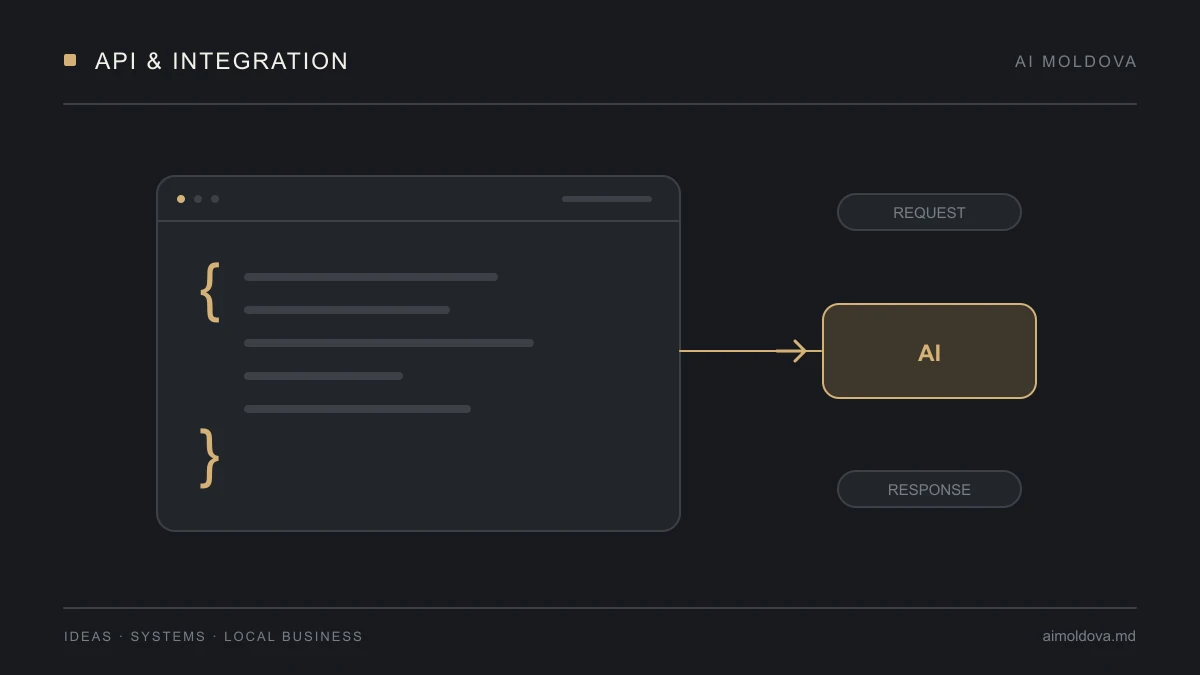
How to implement AI APIs in a business in 2026: from idea to controlled system
Architecture, security, costs, CRM and document integration, testing, transparency and a realistic plan for a business AI project.
Introduction
For companies in the Republic of Moldova, "How to implement AI APIs in a business in 2026: from idea to controlled system" is no longer only a discussion about digital tools. It is an operational decision that affects sales, acquisition cost, customer trust and team speed. A local business needs clear systems: clean data, messages in the customer's language, fast pages, controlled automation and reports that show what actually produces revenue. For “How to implement AI APIs in a business in 2026: from idea to controlled system”, this principle becomes useful only when it is tied to a real workflow and a clearly accountable owner.
AI Moldova is designed as a practical layer on top of those processes. It does not replace strategy, but it shortens the path from analysis to content, execution and optimization. This article explains a method for founders, managers and small teams that want to use AI seriously, technically and measurably. In the case of “How to implement AI APIs in a business in 2026: from idea to controlled system”, the recommendation should be tested on a limited workflow before it is expanded across the company.
Local context and customer intent
Many AI projects start with a chatbot and fail because process, data, ownership, cost limits and measurable business outcomes were never defined. In the local market, people compare quickly, read reviews, message on WhatsApp, switch between Romanian and Russian, and decide based on trust. That is why any AI solution must start from real customer behavior, not from a generic template copied from a different market. In the case of “How to implement AI APIs in a business in 2026: from idea to controlled system”, the recommendation should be tested on a limited workflow before it is expanded across the company.
The first step is to map intent: urgent searches, comparison searches, price questions, quality checks, consultation requests and follow-up conversations. Each intent needs a short answer, a relevant page and a clear path to contact. AI becomes useful when it turns those intents into content and actions. Applied to “How to implement AI APIs in a business in 2026: from idea to controlled system”, this rule keeps technology in service of a commercial outcome rather than making it an end in itself.
Recommended AI architecture
A professional workflow is not one prompt. It is a system with roles: data collection, request classification, answer generation, review, history storage and reporting. For How to implement AI APIs in a business in 2026: from idea to controlled system, the minimum architecture includes chat, a knowledge base, content templates, tone rules and a human escalation path. Applied to “How to implement AI APIs in a business in 2026: from idea to controlled system”, this rule keeps technology in service of a commercial outcome rather than making it an end in itself.
Technically, prompts should be separated from the interface and answers should be auditable. Generated content must consider services, prices, geography, languages, current offers and legal restrictions. That prevents impressive answers that are commercially useless. For “How to implement AI APIs in a business in 2026: from idea to controlled system”, this principle becomes useful only when it is tied to a real workflow and a clearly accountable owner.
Data, content and indexable SEO
For Google, content should be available in HTML with headings, meta descriptions, structured data, canonical URLs and an updated sitemap. If text appears only after client-side interaction, indexation can be weaker. Articles, service pages and FAQs should therefore be generated statically or server-side. For “How to implement AI APIs in a business in 2026: from idea to controlled system”, this principle becomes useful only when it is tied to a real workflow and a clearly accountable owner.
A strong page contains a precise H1, logical H2 headings, substantial paragraphs, local examples and internal links to services, plans and chat. For searches such as business AI API implementation 2026, OpenAI API integration, Claude API Moldova, AI CRM automation, the content must answer the question fully rather than repeat keywords artificially. Structure is more important than keyword density. In the case of “How to implement AI APIs in a business in 2026: from idea to controlled system”, the recommendation should be tested on a limited workflow before it is expanded across the company.
Implementation workflow in 7 steps
Implementation starts with an audit: what the company offers, which pages exist, which channels bring inquiries and where customers drop off. Then the team defines the main scenarios, writes AI instructions, creates templates, connects forms and tests answers with real business examples. In the case of “How to implement AI APIs in a business in 2026: from idea to controlled system”, the recommendation should be tested on a limited workflow before it is expanded across the company.
After launch, the first two weeks should be measured daily. Track repeated questions, conversions, response time, cost per lead and lead quality. AI should be improved from data, not impressions. This discipline turns an experiment into a working business tool. Applied to “How to implement AI APIs in a business in 2026: from idea to controlled system”, this rule keeps technology in service of a commercial outcome rather than making it an end in itself.
Tools and technology stack
A mature setup can combine the OpenAI API for answers, a secure backend for keys, Vercel for publishing, analytics for events, a CRM or spreadsheets for leads and file storage for documents. Not every company needs a complex platform on day one, but every company needs a stable foundation. Applied to “How to implement AI APIs in a business in 2026: from idea to controlled system”, this rule keeps technology in service of a commercial outcome rather than making it an end in itself.
The recommended stack separates the interface, backend, model provider, data retrieval, tools, task queue, logs, evaluations and human approval. Tools should not be chosen because they sound modern. They should solve a concrete problem: faster response, clearer page, easier campaign measurement or faster document production. Technology should be invisible to the client and useful to the team. For “How to implement AI APIs in a business in 2026: from idea to controlled system”, this principle becomes useful only when it is tied to a real workflow and a clearly accountable owner.
Practical examples for Moldova
A workflow can receive a website enquiry, identify the service, retrieve approved information, draft an offer, save the lead to CRM and request manager approval before sending. In this scenario, AI can prepare page copy, answers to questions, ad ideas, a design brief and a tracking plan. The team no longer starts from zero; it starts from a coherent structure that can be checked and adapted. For “How to implement AI APIs in a business in 2026: from idea to controlled system”, this principle becomes useful only when it is tied to a real workflow and a clearly accountable owner.
For a business in Chisinau, details matter: districts, real services, schedule, delivery conditions, warranty, spoken languages and messages that fit the audience. A generic sentence may be correct, but a local sentence is more persuasive. AI needs context, not blind generation. In the case of “How to implement AI APIs in a business in 2026: from idea to controlled system”, the recommendation should be tested on a limited workflow before it is expanded across the company.
Measurement, metrics and optimization
The main metrics are inquiries, conversion rate, cost per lead, time to response, lead quality and the share of conversations that reach an offer. For SEO pages, track impressions, clicks, average position, time on page and assisted conversions. In the case of “How to implement AI APIs in a business in 2026: from idea to controlled system”, the recommendation should be tested on a limited workflow before it is expanded across the company.
Track completion rate, field accuracy, response time, cost per workflow, human interventions, errors, conversion and demonstrated savings against the old process. If a channel brings traffic without inquiries, the problem may be the message, offer or page. If AI answers a lot but does not guide users to action, the instructions need adjustment. Good optimization combines quantitative data with analysis of real conversations. Applied to “How to implement AI APIs in a business in 2026: from idea to controlled system”, this rule keeps technology in service of a commercial outcome rather than making it an end in itself.
Risks and quality rules
Risks appear when AI promises too much, invents information or generates content without review. For documents, healthcare, finance or legal terms, answers should be marked as drafts and reviewed by specialists. For ads, avoid unsupported claims and exaggerated promises. Applied to “How to implement AI APIs in a business in 2026: from idea to controlled system”, this rule keeps technology in service of a commercial outcome rather than making it an end in itself.
The simple rule is: AI proposes, humans approve, data confirms. A serious company protects customer data, keeps brand tone consistent, explains system limits and does not hide that some answers are assisted automatically. Trust is more valuable than speed. For “How to implement AI APIs in a business in 2026: from idea to controlled system”, this principle becomes useful only when it is tied to a real workflow and a clearly accountable owner.
30-day action plan
In week one, document services, frequent questions and offers. In week two, build SEO pages or sections for the most important searches. In week three, connect chat, forms and tracking. In week four, analyze results and adjust messages. For “How to implement AI APIs in a business in 2026: from idea to controlled system”, this principle becomes useful only when it is tied to a real workflow and a clearly accountable owner.
For How to implement AI APIs in a business in 2026: from idea to controlled system, the good result is not a long text or a flashy bot. It is a system that reduces repetitive work and increases the chance that a visitor becomes a customer. When content, automation and measurement work together, AI becomes commercial infrastructure, not digital decoration. In the case of “How to implement AI APIs in a business in 2026: from idea to controlled system”, the recommendation should be tested on a limited workflow before it is expanded across the company.
A practical AI integration architecture for 2026
Start with the process, not the model. Write down the event that begins the workflow, the data entering it, the decision required, the systems touched and the person accountable for the outcome. A useful target is concrete: reduce proposal preparation from forty minutes to ten, classify ninety per cent of enquiries correctly, or answer standard questions within two minutes. The statement 'we want AI in the company' cannot determine an architecture and offers no criterion for deciding whether the pilot should expand, change direction or stop.
An API key never belongs in a browser or distributed mobile application. The request passes through a backend where the user is authenticated, volume is limited, content is validated and cost is attributed to an account. The backend calls the model through an adapter so the application can switch among OpenAI, Anthropic or a specialised model. When code must consume the result, request structured JSON and validate it against a schema before the values enter CRM, billing, publishing or another operational system. Natural language should not silently become trusted database input.
Tools are what turn text generation into automation. The OpenAI Responses API can expose custom functions and hosted tools, while the Claude API returns tool-use blocks. In both designs the model proposes a call and the application decides whether it runs. A function that updates a lead receives only necessary fields, checks permissions and rejects invalid values. Payments, deletion, publishing and outbound customer messages require human confirmation. Do not expose a general execution function when the workflow only needs three narrow, named and auditable actions.
Observability must be designed before launch. Every stage needs an identifier, model and version, timing, token use, estimated cost, requested tools, errors and final decision. Personal data should be masked or excluded, and log access should be separate from ordinary user access. An evaluation set runs whenever the prompt or model changes and covers routine examples, different languages, missing information, prompt injection and refusal paths. Without this foundation, the team discovers regressions through a customer complaint instead of an alert or failed evaluation.
In 2026 transparency is a product requirement, not only a preference. European AI Act transparency duties under Article 50 apply from 2 August 2026 to specified systems and situations. Companies need to establish their role, operating market and applicable obligations with appropriate professional advice. Even when a workflow is not high-risk, a user should understand when they are interacting with AI, how to reach a person and where inaccurate data can be corrected. This article provides technical guidance and does not replace legal analysis for a particular deployment.
A good pilot runs long enough to reveal exceptions while keeping impact bounded. AI Moldova starts with twenty to fifty anonymised real examples, defines an acceptable result, builds the integration in a test environment and releases it to a small group. After launch, time, cost and quality are compared with the previous process. If indicators improve and risk remains controlled, the workflow expands. If not, the team changes the prompt, data source, model or decides that AI is not appropriate for that step. A data-based stop decision is also a professional outcome.
Official sources and further reading
Details used in “How to implement AI APIs in a business in 2026: from idea to controlled system” may change. Check the official source before making a technical or commercial decision.
Contact and social links
AI Moldova is a local AI assistant for business: chat, documents, images, marketing, local SEO and automations.
- Telegram
- adsmoldova77@gmail.com
- +373 60 178 298
- Contact
- Affiliate
- Blog
- Terms
- Privacy
- Cookies
- adsmoldova.md
Location: Republic of Moldova, Chisinau. Created by adsmoldova.md.